
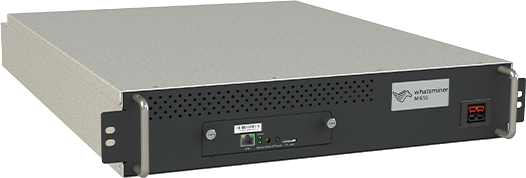
What the M63S is
The WhatsMiner M63S is a hydro-cooled SHA-256 ASIC from MicroBT. The official product listing shows 408T and 18 J/T. Multiplying those figures gives an implied power draw of about 7344W. That places the M63S in a different category from a home hobby box: it is a high-density miner that expects a real power and cooling plan.
Like other Bitcoin ASICs, the M63S is purpose-built. It is not a general GPU server and it cannot pivot into gaming, rendering, or AI workloads. It exists to produce SHA-256 hashes efficiently. That specialization is why an ASIC can outperform GPUs on Bitcoin by such a large margin, but it also means the hardware's value is tied tightly to the mining market.
Hashrate and daily profit math
408 TH/s is 0.408 PH/s. For a Bitcoin miner, daily gross revenue can be approximated as current BTC hashprice x 0.408. If hashprice were $50 per PH per day, gross revenue would be $20.40. If hashprice were $35, it would be $14.28. Pool fees, stale shares, downtime, and transaction-fee variation all move the final number.
Electricity is the unavoidable deduction. At an implied 7.344 kW, the M63S uses about 176.26 kWh per day. At $0.08/kWh, power costs about $14.10 per day. At $0.12/kWh, it costs about $21.15. At $0.18/kWh, it costs about $31.73. At $0.12/kWh, this miner needs roughly $51.80 per PH per day to cover only the ASIC's electricity. That is before coolant pumps or facility fans.
The required computing environment
The M63S provides the compute. The external computer requirement is modest: a laptop, mini PC, or browser-capable device for setup and monitoring. What matters more is network reliability, power monitoring, temperature telemetry, and alerting. A miner this large should not be operated blindly.
GPUs do not carry the power consumption or hashrate for this machine. A GPU rig with high-end cards may consume several kilowatts, but it will not compete in SHA-256 efficiency. If the goal is Bitcoin mining, the ASIC is the computer. If the goal is algorithm flexibility, then a GPU rig is a different project with different coins, drivers, and profitability assumptions.
Power and hydro cooling
A 7344W load can draw about 30.6 amps at 240V before continuous-load derating. In practice, this points toward larger dedicated circuits, higher-voltage distribution, or industrial PDUs depending on the site. The electrical plan should be designed around continuous operation, not a brief peak draw.
Heat is the defining constraint. 7344W x 3.412 is about 25,000 BTU/hr. Hydro cooling moves that heat into liquid, which is easier to direct than hot exhaust air, but the loop still has to reject it. Dry coolers, facility water loops, heat exchangers, pumps, and coolant maintenance become part of mining economics. This is exactly why the industry is moving toward water and immersion systems: they make high-density deployments more manageable than air alone.
When it makes sense
The M63S is best for operators who already have cheap power and hydro-capable infrastructure. It can be a poor fit for a casual home setup because the electrical and thermal load are too large for ordinary rooms and circuits. The miner may be efficient enough to compete in a farm, while still being too demanding for a small space.
The practical question is not whether 408 TH/s is impressive. It is whether your site can run 176 kWh per day at a low rate, reject 25,000 BTU/hr reliably, and keep the miner online enough for the hashrate to matter. If those conditions are met, hydro ASICs like the M63S are part of the modern mining toolkit.