
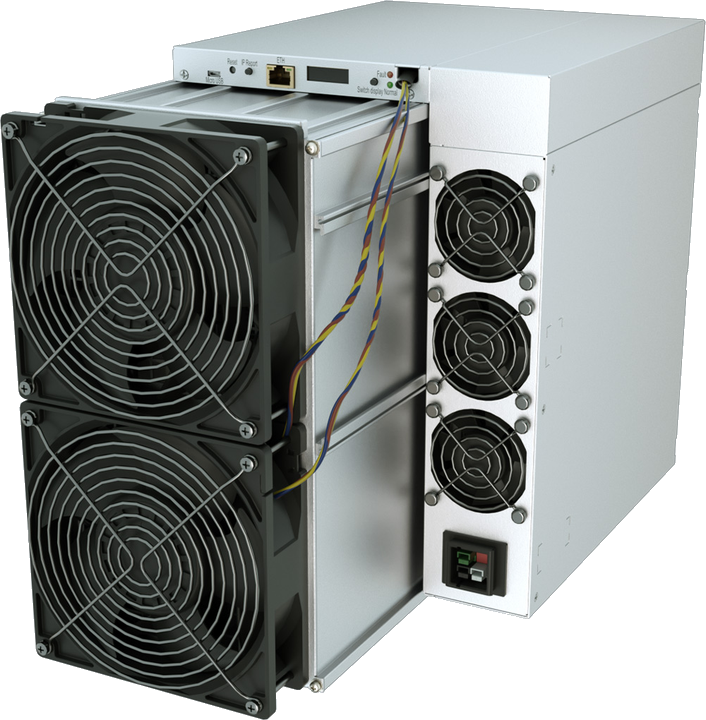
What the S21 XP is built to do
The Antminer S21 XP is an air-cooled Bitcoin ASIC, which means it is a purpose-built computer for SHA-256 hashing. It is not a general desktop, gaming GPU, or AI workstation. Its chips do one narrow job: test enormous numbers of hashes until the mining pool finds valid Bitcoin blocks. Bitmain's current catalog lists the S21 XP at 270 TH/s, 3645W, and 13.5 J/T.
Those three numbers tell the whole operating story. Hashrate is the amount of work the miner contributes. Watts are the power it consumes while doing that work. Joules per terahash is the efficiency score, showing how much energy the miner needs to produce a unit of SHA-256 hashrate. A lower J/T means less electricity per unit of work, which usually matters more than raw hashrate when electricity is expensive.
How hashrate turns into revenue
For Bitcoin ASICs, hashrate is usually quoted in terahashes per second. One petahash is 1000 terahashes, so the S21 XP's 270 TH/s is 0.27 PH/s. Mining revenue changes with Bitcoin price, network difficulty, transaction fees, pool luck, and pool fees. The clean way to estimate daily revenue is: daily revenue = miner PH/s x current hashprice. If current hashprice were $50 per PH per day, this miner's gross revenue would be 0.27 x $50, or $13.50 per day before electricity.
The power bill is not optional, so calculate it separately. Electricity cost per day = watts / 1000 x 24 x electricity rate. For the S21 XP, 3645W is 3.645 kW. That is 87.48 kWh per day. At $0.08/kWh the power cost is about $7.00 per day. At $0.12/kWh it is about $10.50. At $0.18/kWh it is about $15.75. Actual profit is gross mining revenue minus electricity, pool fees, downtime, repairs, cooling overhead, and any financing cost.
Power delivery and the computer you need
The S21 XP should be treated like a dedicated appliance, not a USB device attached to a gaming PC. The ASIC contains the hashboards, control board, fans, firmware, and network interface. A basic laptop, mini PC, tablet, or phone browser can configure the miner's web interface, set pool credentials, update firmware, and watch temperatures. The host device does not supply the hashrate.
A normal 120V household outlet is not the right plan for a 3645W miner. At 240V, 3645W is about 15.2 amps before continuous-load derating. A dedicated 240V circuit is the baseline; many operators prefer a 30A circuit, proper PDU, and wiring sized by an electrician rather than running at the edge of a 20A circuit. GPUs do not help this machine mine Bitcoin. Even premium gaming GPUs cannot compete with SHA-256 ASIC efficiency, and they still need their own power, cooling, and motherboards if used for other coins.
Heat, noise, and airflow
A miner that draws 3645W releases almost all of that power as heat. Using watts x 3.412, the S21 XP produces roughly 12,400 BTU/hr. That is like running several space heaters continuously. If the room cannot exhaust that heat, the miner will raise intake temperature, spin fans harder, lose efficiency, and eventually throttle or shut down.
Air-cooled miners need clean intake air, direct exhaust routing, and enough room for fan noise. Garages, basements, sheds, and small utility rooms often look convenient until summer temperatures arrive. Dust also matters because clogged heatsinks reduce thermal transfer. Even when buying an air-cooled miner, it is worth understanding hydro and immersion systems because the market is moving in that direction: liquid cooling can move heat more predictably, reduce fan noise, and make heat reuse or dense farm layouts easier.
Who the S21 XP fits
The S21 XP makes sense for a miner who wants a current air-cooled Bitcoin ASIC and already has cheap power, ventilation, and space for noise. The machine is compact compared with a hydro rack, but it is still industrial equipment. If your electric rate is high, the same 270 TH/s can look strong on a spec sheet and weak in actual profit once the meter is running.
The break-even hashprice shows the sensitivity. At $0.12/kWh, power costs about $10.50 per day, so this 0.27 PH/s miner needs roughly $38.90 per PH per day just to cover electricity. That does not include downtime or cooling overhead. Treat the S21 XP as an electricity-arbitrage machine: the hardware matters, but the power contract and heat plan decide whether the hashrate is useful.