
Why hydro changes the mining setup
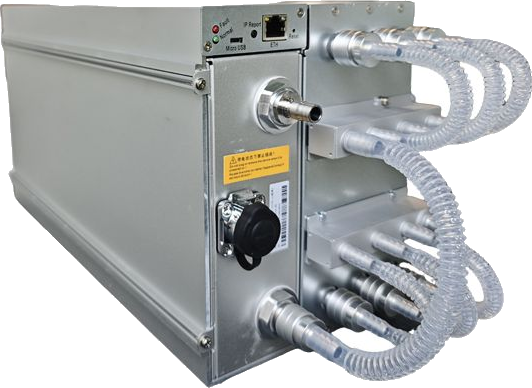
The Antminer S21 XP+ Hyd is a SHA-256 Bitcoin ASIC that uses liquid cooling to move heat away from the hashboards. Bitmain's public catalog lists it at 480 TH/s, 5280W, and 11 J/T. Compared with older air-cooled miners, the efficiency number is the major attraction: fewer joules per terahash means less energy spent for the same amount of hashing.
Hydro cooling does not make heat disappear. It moves heat into liquid so the operator can reject it through a dry cooler, radiator, heat exchanger, or facility loop. That can make a farm quieter and denser, but it adds pumps, plumbing, leak management, coolant quality, filters, monitoring, and maintenance. The miner itself is only one component in the system.
Hashrate, hashprice, and true profit
At 480 TH/s, the S21 XP+ Hyd contributes 0.48 PH/s. A quick revenue estimate is gross daily revenue = 0.48 x current BTC hashprice. If hashprice were $50 per PH per day, gross revenue would be $24.00 per day before pool fees and power. If hashprice fell to $35, gross revenue would be $16.80. That swing can happen without the miner changing at all.
Power cost is the harder floor. The S21 XP+ Hyd draws 5.28 kW, or 126.72 kWh per day. At $0.08/kWh, electricity is about $10.14 per day. At $0.12/kWh, it is about $15.21. At $0.18/kWh, it is about $22.81. At $0.12/kWh, the miner needs about $31.70 per PH per day just to cover its own electricity. Add pumps, fans, facility cooling, downtime, pool fees, and capex before calling the result profit.
Computing power and infrastructure
The ASIC supplies the computing power. You do not need a workstation GPU, CPU miner, or gaming rig to run it. A cheap laptop, mini PC, or mobile browser can configure the control board, point the miner at a pool, and monitor temperatures. The network should be stable, wired Ethernet is preferred, and remote monitoring should be treated as operational infrastructure.
A 5280W continuous load is not appropriate for a casual outlet. At 240V, the miner alone draws about 22 amps, and continuous-load planning pushes the circuit requirement higher. Many hydro deployments belong on 30A or larger dedicated circuits, PDUs, and in some cases higher-voltage industrial distribution depending on the exact PSU and site design. GPUs cannot take over SHA-256 work from this miner; they are different silicon aimed at different algorithms.
Heat output and water-loop reality
Every watt becomes heat. At 5280W, the S21 XP+ Hyd produces about 18,000 BTU/hr. Instead of blasting that heat into a room with fans, the hydro loop carries it away in liquid. That is useful because liquid has far better heat capacity than air, but it also means the loop must reject 5.28 kW around the clock. If the loop warms up, the miner warms up with it.
Water cooling is where high-density mining technology is heading because the limits of air cooling are easy to feel: noise, dust, uneven airflow, and hot aisles. Hydro and immersion systems can improve thermal stability and open heat-reuse options, such as greenhouse, shop, or water pre-heating projects. The tradeoff is complexity. A small operator should price the entire loop, not just the miner.
Best-fit buyer
The S21 XP+ Hyd fits an operator who already understands electrical service, coolant handling, and facility heat rejection. It is not the simplest first miner, but it can be attractive where electricity is cheap and a hydro loop can run efficiently. The 11 J/T efficiency helps protect margins during weaker hashprice periods, but it does not override expensive power.
The practical decision is whether the extra infrastructure lowers the total cost per terahash. If hydro lets you run denser hardware, reduce fan maintenance, stabilize summer operation, or reuse heat, it can be a real advantage. If it creates pump failures, leaks, and expensive installation work, the hashrate headline can become a distraction.