
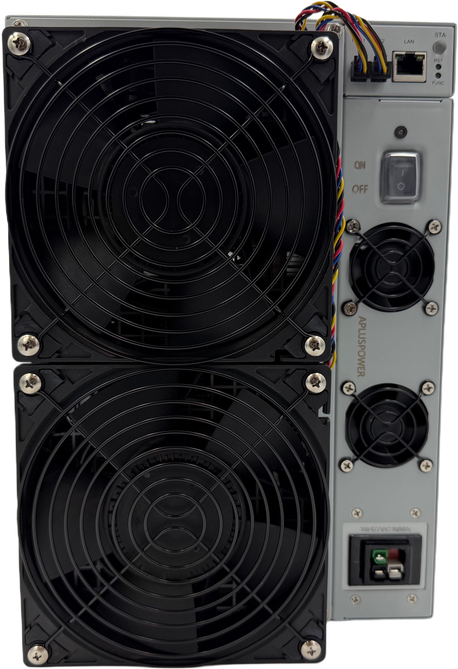
What the A16XP brings
The Avalon Miner A16XP-300T is a SHA-256 ASIC listed by Canaan at 300T and 3850W. Dividing watts by terahashes gives an implied wall-plug efficiency around 12.8 J/TH. That puts it in the modern high-efficiency Bitcoin miner conversation without requiring a hydro loop like many denser machines.
The A16XP is still industrial equipment. It is designed to turn electricity into Bitcoin mining shares all day, not to sit beside a normal workstation. The hashrate number tells you how much work it can submit to a pool, but the wattage number tells you how quickly the operating cost arrives.
Hashrate and power-cost math
300 TH/s is 0.30 PH/s. Daily gross revenue can be estimated by multiplying 0.30 by current Bitcoin hashprice. At a hypothetical $50 per PH per day, the miner would gross about $15.00 per day before costs. At $35 hashprice, it would gross $10.50. That is why miners watch hashprice closely: the same ASIC can swing from profitable to unprofitable without changing its own performance.
Electricity cost is 3.85 kW x 24 x your kWh rate. That is 92.4 kWh per day. At $0.08/kWh, the miner costs about $7.39 per day to power. At $0.12/kWh, it costs about $11.09. At $0.18/kWh, it costs about $16.63. At $0.12/kWh, the A16XP needs about $37.00 per PH per day just to cover electricity, before pool fees, cooling, repairs, or downtime.
Computer, GPU, and power requirements
The A16XP contains the specialized compute hardware. A separate computer is only needed to access the miner's web dashboard, configure the pool, set networking, and check logs. Any basic modern laptop, office PC, or mini PC can handle that job. The quality of Ethernet, power monitoring, and remote alerts is more important than CPU or GPU power.
GPUs cannot economically replace the A16XP for Bitcoin mining. A high-end GPU rig may draw comparable electricity across multiple cards, but it produces a tiny amount of SHA-256 work compared with an ASIC. If you already own GPUs, they may be better evaluated for GPU-friendly coins or non-mining workloads. For Bitcoin, the A16XP is the dedicated engine.
Heat and airflow
The A16XP's 3850W draw becomes heat. Using watts x 3.412, the miner produces roughly 13,100 BTU/hr. That heat has to move out of the room as fast as it is created. If the miner recirculates warm exhaust into its intake, efficiency and uptime suffer. Intake temperature, dust, and exhaust routing are daily operating variables, not afterthoughts.
Air-cooled miners are simpler than hydro miners, but they make noise and push a lot of hot air. Water cooling and immersion are where the industry is heading for better efficiency, density, and heat management. Even if the A16XP itself is operated as an air-cooled unit, the operator should understand that future upgrades may involve liquid loops, dry coolers, or heat reuse rather than just bigger fans.
Where it fits in a mining plan
The A16XP fits operators who want current-generation SHA-256 efficiency without immediately building a hydro setup. It still needs a dedicated 240V electrical plan. At 240V, 3850W is about 16 amps before continuous-load derating, so many operators will prefer a 30A circuit, proper cabling, and a PDU rather than running at the edge of a small breaker.
The right way to compare it is not only upfront price per terahash. Compare total cost per operating terahash: hardware price, power rate, expected uptime, cooling cost, firmware stability, warranty path, and resale market. A miner with slightly lower hashrate can outperform a larger machine if it stays online with less power and less heat stress.